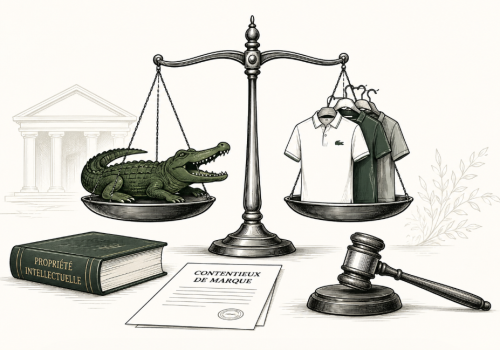

Swift Home: how far can a celebrity control the use of their name?
An illustration of the U.S. trademark opposition proceedings with a comparative look at France
By Maëva Gomez, Attorney

On February 11, TAS Rights Management LLC, the company managing the rights of singer Taylor Swift, filed an opposition against the U.S. trademark application for “Swift Home” submitted by CathayHome Inc. for bedding products.
The opposition was filed before the Trademark Trial and Appeal Board (TTAB), the administrative body within the United States Patent and Trademark Office (USPTO) responsible for opposition and cancellation proceedings. The opposition mentioned both a likelihood of confusion with prior marks and a potential false suggestion of connection with the singer. Shortly after the opposition was filed, the applicant withdrew the application.
An opposition based on two pillars of the Trademark Act
- Likelihood of confusion – Section 2(d)
Section 2(d) of the Trademark Act allows a mark to be refused registration if there is a likelihood of confusion with a prior mark.
In the Swift Home case, the argument was that consumers could mistakenly believe the bedding products were associated with or endorsed by the singer, based on:
-
- Prior rights: the opponent’s registrations and usage predated the SWIFT HOME & Design application.
- Similarity of the marks: dominance of the term “SWIFT,” with visual, phonetic, and conceptual similarities.
- Similarity of products: the contested products (pillows, blankets, bedding) overlap with those covered by prior registrations.
- Distinctiveness and fame: Taylor Swift’s exceptional renown heightens the risk of association in consumers’ minds.
- Commercial context: the applicant’s promotion of multiple partner brands could amplify the impression of an official collaboration.
- //////////
- False association – Section 2(a)
Section 2(a) prohibits registration of a mark that suggests a false association with a person.
In this case:
-
- “SWIFT” is immediately recognized by the U.S. public as referring to Taylor Swift;
- the applicant could not ignore her global fame when filing;
- the font used resembles the singer’s handwritten style;
- no consent or license was obtained;
- use of “SWIFT” for bedding and home décor could create the erroneous impression of endorsement, sponsorship, or official authorization.
Even though “Swift” is a common surname, the association with Taylor Swift’s fame was sufficient to trigger this provision.
Part of a broader brand protection strategy
This action is not isolated. According to the World Intellectual Property Organization (WIPO), Taylor Swift has filed over 300 U.S. trademark applications through TAS Rights Management, LLC. Internationally, WIPO’s global database listed 438 marks registered in at least sixteen jurisdictions as of last September.
These registrations cover a wide spectrum: her name, phrases from songs, album and tour titles, and personal elements, including the names of her three cats.
Such strategy enables:
-
- control of commercial exploitation;
- oversight of merchandise;
- securing digital uses;
- preserving coherence across each artistic “era” and its economic exploitation.
The Swift Home opposition reflects ongoing vigilance to prevent dilution, trivialization, or opportunistic appropriation of her brand.
Comparative perspective: French trademark law
In France, a similar situation is assessed under two axes:
Risk of confusion with a prior mark – Article L.711‑3, 1°, b) of the French Intellectual Property Code (CPI) allows refusal or cancellation of a mark if it is identical or similar to a prior mark for identical or related goods/services, creating a likelihood of confusion, including associative confusion.
Violation of personality rights – Article L.711‑3, 8° CPI allows refusal or cancellation if the mark infringes personal rights, including a surname, pseudonym, or image. This is comparable to the U.S. “false suggestion of a connection” and protects a celebrity’s identity independently of commercial confusion.
Trademarks and celebrities: Total control
The Swift Home case illustrates that in the U.S., combining Section 2(d) (likelihood of confusion) with Section 2(a) (false association) provides celebrities with a broad legal arsenal.
Through systematic, anticipatory filings, a celebrity can exercise near-total control over the use of their name across different sectors. Trademark registration becomes a strategic tool for brand governance, far beyond simple defensive protection.
Sources:
- TAYLOR SWIFT SWIFT HOME TRADEMARK opposition: https://fingfx.thomsonreuters.com/gfx/legaldocs/xmvjqzkrbpr/TAYLOR%20SWIFT%20SWIFT%20HOME%20TRADEMARK%20opposition.pdf
- Trademark Act – Section 2: https://tmep.uspto.gov/RDMS/TFSR/current#/current/sec-be547ab1-b587-4b44-abc6-3ca12e56141d.html
- WIPO Magazine: Taylor Swift trademark strategy: https://www.wipo.int/en/web/wipo-magazine/articles/taylor-swift-trademark-strategy-a-model-for-artist-ip-protection-78728
.
Swift Home: how far can a celebrity control the use of their name?
An illustration of the U.S. trademark opposition proceedings with a comparative look at France
By Maëva Gomez, Attorney